
Incident Update 4︱Shockwaves on TikTok: Understanding the international reaction to the assassination of Charlie Kirk
Authors & Organization
Benjamin Steel, Diya Jiang, Mathieu Lavigne
Organization: Media Ecosystem Observatory
Key takeaways
Conversation went global: Discussion about Kirk’s death went far beyond American borders. In total, users outside the United States produced 42% of videos, and received 42% of the total views and 33% of likes.
Engagement was highest in English-speaking countries: While U.S. creators dominated conversation, users in other English-speaking countries, particularly Canada and Australia, posted at similar rates relative to their population size.
Political violence was condemned globally: While the incident generated polarized debates about Charlie Kirk’s legacy and the U.S. political context, content creators globally expressed predominantly critical reactions to political violence, with only 1% expressing support.
Introduction
The assassination of Charlie Kirk triggered a vast social media discussion both in the United States and internationally. As the U.S.’s polarized context appears to increasingly shape political debates abroad, this event provides a window into how online conversations unfold after instances of political violence, shedding light on both the transformation of existing tensions and the emergence of new ones.
In Update 2, we conducted a topic modelling of the key narratives present on X in Canada and internationally. We found that initial discussions were driven by conspiratorial and partisan narratives, before shifting toward sustained debates over political violence and free speech. Canadian discourses mirrored those in the U.S. but remained limited in volume and attention.
In this update, we expand on Update 2 by examining the global reaction to Charlie Kirk’s assassination on TikTok. This platform is particularly relevant for studying the global conversation because its content-driven algorithm, which is less reliant on pre-existing social networks, encourages otherwise unconnected, multilingual audiences to engage in the same conversation. We focus on this platform to identify the countries where discussion of Kirk’s assassination was most widespread and to examine how content creators in these countries positioned themselves around three central themes in the discussion: Charlie Kirk and his legacy, Donald Trump, and political violence in the U.S. This analysis contributes to a deeper understanding of the international echoes of U.S political shocks and how they shape global conversations about political violence.
Key questions
This update aims to answer the following two questions:
Which countries generated the most discussion about the event?
How did reactions to the event vary between countries?
Approach and Considerations
To answer these questions, we collected TikTok videos using a two-step approach: first, by searching for posts containing the terms “charlie” and “kirk” in their descriptions, and second, by collecting the posts related to these videos (i.e., Related content). In total, we collected 7,465 videos in the weeks following the assassination (Sept. 12 - Nov. 4), with the post creation times ranging from the day of the event (Sept. 10) up to Nov. 4.
To analyze the content of the videos, we used fine-tuned large language models (LLMs) and other computational techniques to find the main issues of discussion, and stances on those issues, in the video descriptions and transcripts. This classification involved a small and known error. For this reason, we excluded videos using languages where the models perform poorly (e.g., Vietnamese).
Given resource constraints, this update’s data collection was not exhaustive and does not capture the full universe of TikTok posts about the assassination. Our approach relied on searches and snowball retrieval of related posts, which tend to prioritize content with higher visibility, stronger engagement signals, or greater algorithmic reach. Although this method does not retrieve every relevant post, it is appropriate for identifying the dominant narratives, most circulated reactions, and cross-national patterns that shaped discussions on TikTok. As such, the dataset offers a strong representation of the most prominent narratives and reactions surrounding the event.
1. Which countries generated the most discussion about the event?
We started by examining how many videos users from each country posted in response to the Charlie Kirk assassination, as well as the engagement they received in terms of views and likes. Figure 1 shows the total number of videos posted by the top five countries, with all remaining countries grouped in an “Other” category. Although the top-five selection is based on production volume, the figure also reports the views and likes these videos received. While these plots depict that the majority of posts emerged in the U.S. (where the assassination took place), they also demonstrate that the conversation extended far beyond U.S. borders. Canada, the United Kingdom, Brazil, and Australia stood out for both the number of posts they produced and the engagement those posts received, with many other countries contributing smaller but noticeable shares. In total, users outside the United States produced 42% of videos, and received 42% of the total views and 33% of likes.
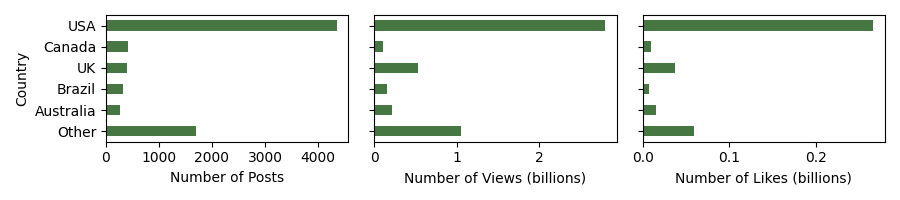
Figure 1. Top 5 countries of origin of videos on the subject of Charlie Kirk, sorted by absolute number of posts.
However, these raw numbers can be skewed by the population size of each country. To account for this, Figure 2 shows the number of posts relative to a country’s population size. Here, another pattern emerges: on a per-capita basis, users from other English-speaking countries, especially Australia and Canada, posted at a comparable rate to those in the United States.
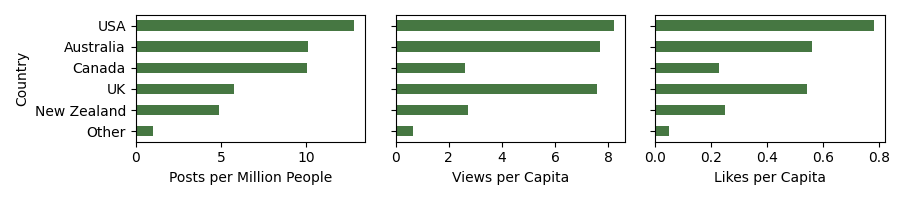
Figure 2. Top 5 countries of origin of videos on the subject of Charlie Kirk, sorted by number of posts relative to the population of the country.
We hypothesize that we observe these trends for a variety of reasons. Australia’s high engagement may be explained by the success of Turning Point Australia, a youth-oriented conservative organization modeled after Charlie Kirk’s Turning Point USA. Founded in 2019 by Australian commentator Joel Jammal, the organization gained visibility and developed ties with Australian conservative figures. While Kirk was not formally the lead of the Australian branch, he frequently commented on Australian politics, criticizing government policies on issues such as free speech, COVID-19 restrictions, and immigration. Canada’s high posting rate likely reflects its geographic and cultural proximity to the U.S., as well as the interconnectivity between their information ecosystems, which exposes Canadians to U.S. political media and influencers. Shared platforms and a high level of cross-border media consumption mean that Canadian users are consistently exposed to American political narratives, especially those involving high-profile political elites. Despite geographic distance, the UK and New Zealand also demonstrated high engagement, probably due to their shared anglophone information environments.
In the middle and right panels of Figure 2, we divide the views and likes of videos from each country by that country’s population. Although online audiences are highly globalized, this measure provides a rough proxy for how the content performed relative to its ‘natural’ home audience. In general, engagement per capita aligns with posting volume, although posts from the United Kingdom received more engagement and those from Canada received less engagement, despite their posting volumes. These patterns likely reflect variation in the global reach of creators who posted about Charlie Kirk.
Overall, these patterns demonstrate that while the conversation around Kirk’s death was rooted in the American context, it became a part of a broader, transnational discourse. The clustering of engagement within Anglophone countries also highlights the linguistic and ideological pathways through which American political discourse can travel internationally and how global audiences selectively participate in it.
2. How did reactions to the event vary between countries?
To understand not just where the discussion originated, but how it unfolded, we analyzed how content creators positioned themselves with respect to key themes associated with the incident. We identified three topics that were both highly relevant and frequently mentioned across countries, with an overview of the nature of the conversation below:
Charlie Kirk (6,224 videos) - The polarized reception of Charlie Kirk and his legacy
Donald Trump (667 videos) - The U.S. political climate under Donald Trump, and Charlie Kirk’s connection to Trump and the MAGA movement
Political Violence in the U.S. (3,881 videos) - The perceived state, (il)legitimacy, and implications of political violence in the U.S.
For each video, we assessed if one or more topics were present. Then, for each topic, we classified the stance expressed toward the topic as in favour, against, or neutral. A ‘favour’ stance indicates that the video expressed sympathy, approval or support for the topic (e.g., praising Kirk or endorsing Trump). An ‘against’ stance captures disagreement, criticism, or condemnation (e.g., denouncing Kirk’s rhetoric or rejecting violence). ‘Neutral’ indicates that the poster mentioned the topic without using overtly positive or negative language (e.g., introducing news about the assassination, the suspect, or the memorial without commenting). Importantly, this does not necessarily mean they hold neutral views on the topic. Stances were automatically classified using validated LLMs.
For each topic, we compared the share of videos expressing positive, negative, and neutral stances across the five countries with the highest volume of discussion, grouping all other countries into an ‘Other’ category. This strategy helps avoid misleading interpretations that could arise from countries with few videos on a given topic. As illustrated in Figure 3, these topics capture three dominant dimensions of the online discussion related to Charlie’s assassination:
Charlie Kirk: Audiences were divided in their views of Kirk, what he stood for, and his legacy. Overall, posts were roughly evenly split among positive, negative, and neutral stances.
Donald Trump: Discussion of Donald Trump showed a similar polarized structure. Stances were generally more positive (favor) in the U.S., Brazil, and Mexico, than in Spain or the UK, where mentions of Trump were predominantly negative. Mentions of Trump were comparatively infrequent in our subset of videos originating from Canada.
Political Violence in the U.S.: In contrast, attitudes toward political violence were consistent across the board. Across all countries, users overwhelmingly expressed negative stances (against) toward violent political actions.

Figure 3. Breakdown of stance on three prominent topics related to Charlie Kirk’s assassination.
Overall, this analysis highlights how the assassination of Charlie Kirk has generated moral and emotional reactions globally, not only around Charlie Kirk himself, but also high-level political figures like U.S. President Trump, and political violence in democratic politics. The widespread condemnation of violence on TikTok, despite ideological division on other topics, underscores how U.S. political developments can serve as catalysts for global reflection on the use of political violence in politics and the fragility of democratic norms.
Conclusion
The international discussion and engagement with Charlie Kirk’s assassination on TikTok demonstrates how far U.S. political events now resonate beyond American borders. Our findings show that the global sum of users produced nearly as many videos – and drew comparable engagement – as American users, highlighting how major U.S. political shocks can quickly become a shared topic of interest across the broader online information ecosystem. This was particularly visible in English-speaking countries such as Canada, Australia, and the U.K., where shared language, media environments, and cultural proximity appear to facilitate interest in and engagement with U.S. political events.
Overall, online reactions to the event reflected both polarization and convergence. On one hand, opinions toward Charlie Kirk and Donald Trump were largely divided, underscoring the polarized nature of both figures as public personas, and how partisan identities can travel internationally through networks of media and influencers. On the other hand, global online discourse overwhelmingly condemned political violence. This suggests that while political polarization exists globally, it does not extend to attitudes toward political violence, and norms against violence remain widely upheld.
Taken together, this analysis shows that U.S political shocks can trigger large-scale, cross-border conversations, especially within Anglophone spaces, and provoke moments of international moral reflections.
Appendix
Prompt used for stance detection:
System Prompt: "You are an expert at analyzing stances in documents.",
User Message: """Your task is to determine the stance expressed towards a specific target in the given document. Consider both explicit and implicit indicators of stance.
Instructions:
1. Carefully read the document while focusing on content related to the provided stance target.
2. Classify the stance as one of:
- FAVOR: Supporting, promoting, or agreeing with the target
- AGAINST: Opposing, criticizing, or disagreeing with the target
- NEUTRAL: Presenting balanced or objective information about the target
Input:
Document: [text]
Stance target: [noun phrase]
Output format:
Stance: [FAVOR/AGAINST/NEUTRAL]
Reasoning: [Brief explanation citing specific evidence from the text]
Examples:
Input:
Document: "Research shows that diverse communities have higher rates of innovation. Cities with more international residents see increased patent filings and startups."
Stance target: immigration""",
Prefilled Model Response: """Output:
Stance: FAVOR
Reasoning: Text implicitly supports immigration by highlighting its positive economic impacts through innovation and business creation.
""",
User Message: """Input:
Document: "Tech companies want self-governance of social media, while lawmakers push for oversight. Recent polls show the public remains divided."
Stance target: social media regulation""",
Prefilled Model Response: """Output:
Stance: NEUTRAL
Reasoning: Presents both industry and government perspectives without favoring either side.
""",
User Message: """Input:
Document: "Standardized test scores correlate more with family income than academic ability, while countries using alternative assessments report better outcomes."
Stance target: standardized testing""",
Prefilled Model Response: """Output:
Stance: AGAINST
Reasoning: Implies tests are flawed by linking them to wealth rather than ability and noting superior alternatives.
""",
User Message: """Input:
Document: "Some remote workers report higher productivity, others struggle with collaboration. Companies are testing hybrid models."
Stance target: remote work""",
Prefilled Model Response: """Output:
Stance: NEUTRAL
Reasoning: Balances positive and negative aspects of remote work without taking a position.
""",
User Message Template: f"""---
Document: "{doc}"
Stance target: {stance_target}""",
Prefilled Model Start: """Output:
Stance: """
Feature Image: Charlie Kirk speaking with attendees at the 2024 AmericaFest at the Phoenix Convention Center in Phoenix, Arizona, by Gage Skidmore, is licensed under CC BY-SA 2.0.