
Incident Update 5︱Mapping Controversial and Polarized Claims Following the Assassination of Charlie Kirk
Authors & Organization
Mika Desblancs-Patel, Esli Chan, Ben Steel, Mathieu Lavigne
Organization: Media Ecosystem Observatory
Key takeaways
Most prominent claims contained a mix of speculation, blame, and critique: Claims about the assassination of Charlie Kirk on X and TikTok primarily focused on partisan blame, critique of Kirk, and speculation about the shooter’s identity and motive.
Users were more likely to refute than to promote polarizing claims: Across both X and TikTok, users predominantly directly refuted or offered competing narratives to polarizing claims rather than endorsing them. While X produced a higher volume of posts, TikTok drove substantially greater engagement.
Polarization emerged from reactions to Kirk’s death: Claims related to the celebration of Kirk’s death attracted the greatest volume of posts and engagement and showed the sharpest polarization. The conversation centered more on the incident’s political ramifications than the circumstances of the death.
Influencers lead the discussion in Canada: Influencers were the most active voices discussing Charlie Kirk and received the most engagement in Canadian online spaces, particularly in conversations about public reactions and Kirk’s legacy.
Introduction
In this update, we aim to explore how polarized the conversation was following Kirk’s death by identifying the most popular claims made following his assassination and evaluating the extent these claims were agreed with (supported), disagreed with (refuted) or its themes discussed (other). To do so, we analyze the top claims that were made on X and TikTok in the aftermath of the shooting of Charlie Kirk on September 10th. More specifically, we evaluate the prevalence of these claims, the distribution of users’ opinions about them, how they circulated online, and the role Canadian media, politicians, and influencers played in their dissemination.
In a previous incident update (IU2), we used topic modelling methods to identify and group posts discussing similar themes. However, while thematic analysis of the incident helps us identify what people talked about, it does not distinguish trends in how users talk about an event. For example, IU2 found that users initially discussed the “transgender identity of the shooter” but did not distinguish between the argument that the shooter was trans, those claiming that trans identity was unrelated, and those referring to this narrative without making an explicit judgment about its truthfulness.
Key questions
We define a ‘claim’ as a meaningful and interesting statement or opinion that presents something as fact. We specifically look at the following questions:
What claims about Charlie Kirk’s assassination circulated the most on X and TikTok?
How did these claims emerge?
Who circulated these claims in the Canadian information ecosystem, and how much engagement did they receive?
Approach and Considerations
In a dataset of X and TikTok posts from September 5 to October 1, 2025, we extracted the most prominent claims by the number of posts count that advanced a narrative related to the death of Charlie Kirk, omitting generic statements (e.g., ‘Charlie Kirk is dead’) and manually identified claims that expressed an original stance or perspective on the incident (e.g., “Leftists are responsible for the murder of Charlie Kirk”). We then used a stance analysis model to evaluate how people engaged with these top claims in three main categories:
supporting: a post directly confirms or provides strong circumstantial evidence supporting a claim;
refuting: a text directly contradicts the claim or undermines the claim’s plausibility without explicit denial;
other: a text is thematically related to the claim but the claim is neutral or the model doesn’t express an opinion for or against it.
For example, suppose we had this post:
"Saw a clip of Charlie Kirk. That was horrific. Seen a lot of attention seeking lunatics on here celebrating his execution. Killed for having an opinion/debate and a lot of you sick individuals were cheering when it happened. He was a husband and a father."
We could evaluate the post against different claims and infer their relationship as follows:
People celebrated the death of Charlie Kirk - supporting, the text’s author explicitly states they saw users "celebrating" and “cheering”.
Charlie Kirk’s assassination was met with universal mourning - refuting, the text provides examples of individuals who did not mourn but instead cheered.
Left-wing individuals celebrated Kirk’s death - other, while the text refers to people celebrating and the fact that he died, the author does not identify their political affiliations.
By isolating specific statements to evaluate who initiates and amplifies them in the online ecosystem, we provide a granular characterization of how polarized and controversial statements emerge and influence political discourse.
1. What claims about Charlie Kirk’s assassination circulated the most on X and TikTok?
1. Public response to Kirk’s death
Public discourse following his death yielded top claims about what the appropriate response should be, extending to cultural conversations about public behavior:
“People celebrated that Charlie Kirk died”
“People should get fired for celebrating Charlie Kirk’s death”
“Jimmy Kimmel’s comments about Charlie Kirk were inappropriate or incendiary”
2. Partisan critique
Critique of the left
Users deliberated the responsibility of the ideological left for Kirk’s death and political violence, their reactions to his death, and how much they care about free speech. These statements include:
“Leftists are responsible for the murder of Charlie Kirk”
"The Democrats are responsible for the murder of Charlie Kirk"
“Leftists are responsible for political violence”
“Left-wing individuals celebrated the fact that Charlie Kirk died”
“The left does not care about free speech”
Critique of the right
In contrast, discourse about the ideological right was limited within the top 17 claims with only one prominent claim focused on free speech:
“The right does not care about free speech”
3. Speculation about the shooter
Speculation around the shooter’s connection to foreign actors, identities, and ideologies demonstrated the public’s desire to understand the underlying motive of the assassination. Claims included:
“Israel was involved in the shooting of Charlie Kirk”
“The Shooter or Tyler Robinson was radicalized by the left”
“The Shooter or Tyler Robinson was radicalized by trans ideology”
“The shooter or Tyler Robinson is a Groyper”
“Trans ideology was part of the murder”
4. Criticism of Charlie Kirk
A large number of users discussed the character and legacy of Kirk in relation to the claim:
“Charlie Kirk was a racist and a bigot”
5. Schools are indoctrinating students
In line with partisan critiques of the left, many users accused universities (and schools more broadly) of indoctrinating students with left-wing ideas. Some users argued it was these ideas the shooter used to justify his actions. The main claim discussed was:
“Schools are indoctrinating students”
6. Antifa should be declared a terrorist organization
After the assassination, many users online linked the shooter to ANTIFA and, in late September, President Trump announced an Executive Order to have the organization designated as a terrorist organization. Those discussions are reflected in the claim:
“Antifa should be declared a terrorist organization”
We note that the above should not be taken to mean they were the only claims made specifically about Charlie Kirk and the assassination, but rather the ones that were most consistently identified in our data, which is sensitive to the consistency of the language used when users make a statement.
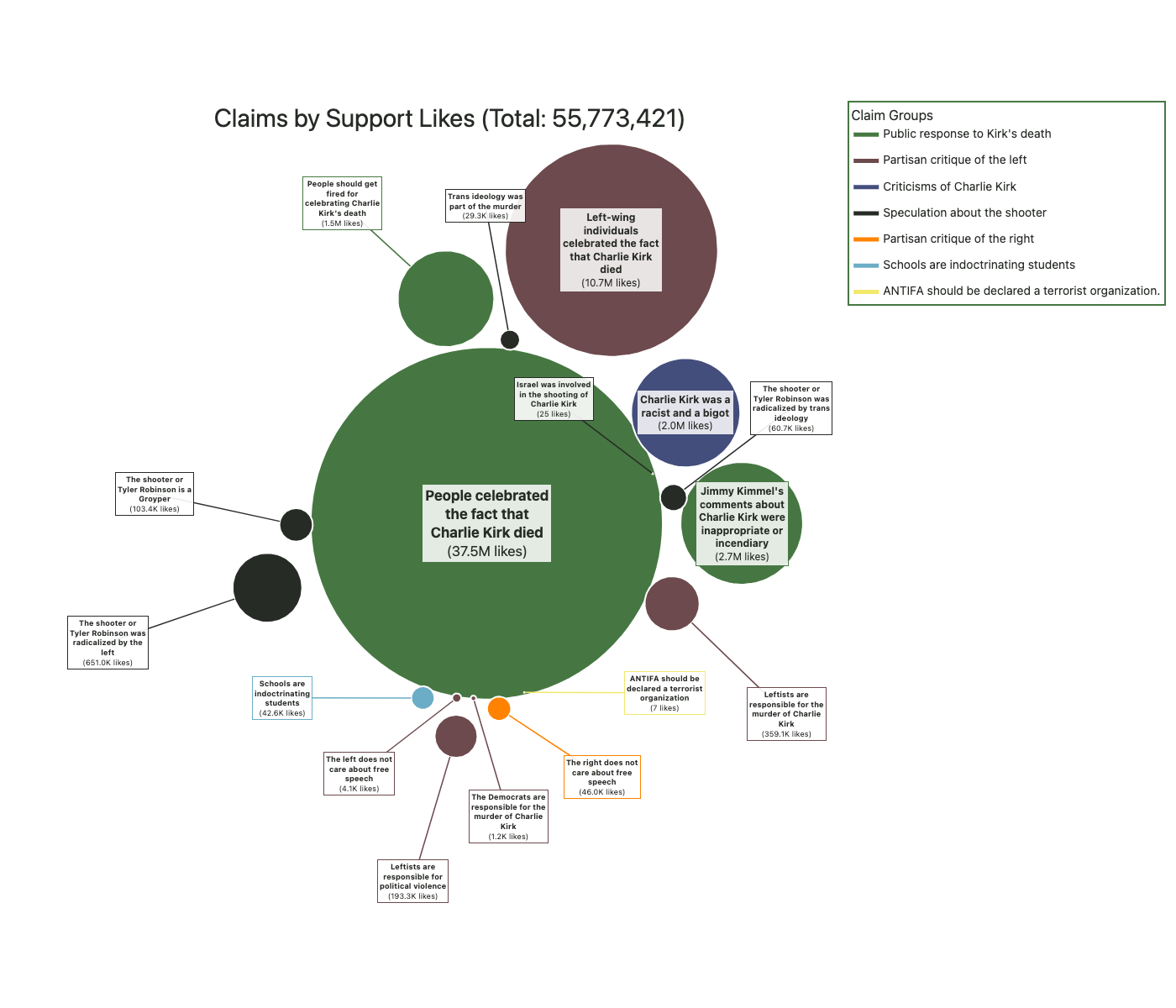
Figure 1: Sum of likes across posts on X and TikTok supporting each claim, labelled by individual claim, its total number of likes, and coloured by claim group.
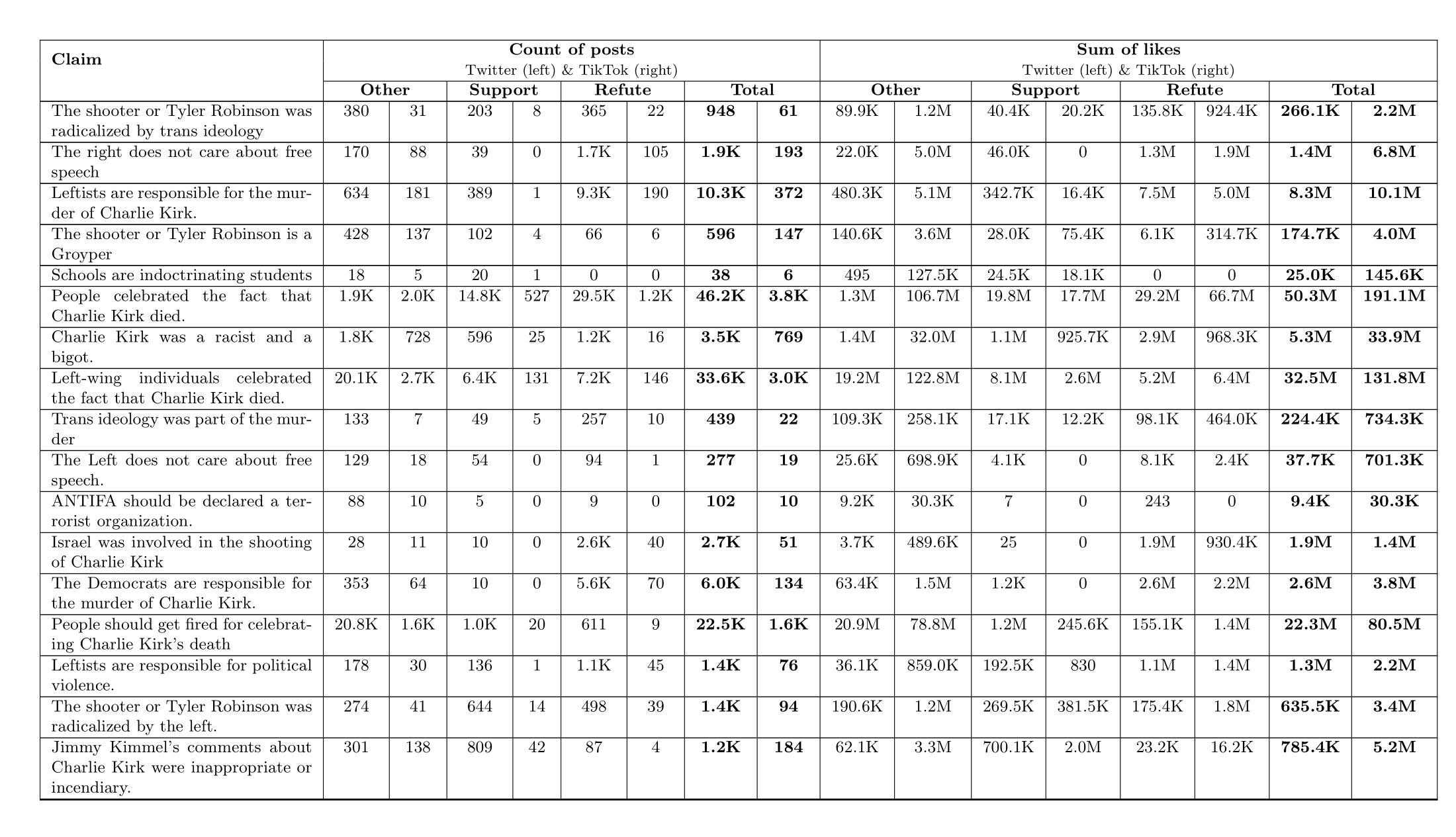
Table 1. Count of posts and likes per stance for each claim
To assess how widely each claim circulated on X and TikTok, Figure 1 reports the total number of likes on posts supportive of each claim, with colours distinguishing the six claim groups. Table 1 provides a broader view of the discussion by reporting, for each claim, the total number of posts and likes per stance (support, refute, other). Overall, we find that other stances on posts largely outnumbered both supporting and refuting posts for most claims. We take this to reflect both the high number of posts in which users did not clearly state a position, the difficulty our model faced in detecting implicit stances in context-dependent social media data, but also the thematic uniformity of our dataset; all posts were about Kirk’s death, and the ensuing online conversation. Nevertheless, we identify three key points:
(1) X produces narratives while TikTok popularizes them
While we found 12 times more posts related to the claims on X than TikTok (~133,000 vs. ~10,000), TikTok tallies up about 3.5 times more likes than X (~478,000 vs. ~133,000). In other words, narratives (posts) appear to originate on X, but engagement is substantially higher on TikTok. This pattern is even more stark for posts expressing a support or refute stance: across all claims, there were 30 times more X posts (~85,000 vs. ~2,700), but TikTok posts generated 30% more likes than X (~115 million vs ~85 million). Taken together, these findings suggest that while X serves as a major site of content production, TikTok is the primary site of amplification, with narratives gaining far more visibility and impact once they reach TikTok.
(2) Celebrations of Kirk’s assassination was a driver of polarization
As seen in Figure 1, claims asserting that people are celebrating Kirk’s assassination garnered the most interest overall. They represented by far the most supported type of claims by engagement and exhibited highly polarized debate, as highlighted by the high volume and engagement of posts both supporting and refuting celebration claims. Supportive posts generally accused people of celebrating Kirk’s death, while refuting posts emphasized mourning. This suggests that debates over the aftermath and public reactions to Kirk’s assassination received more engagement than accusations about the motive or causes of the incident. Users were interested in the potential fallout and emergence of socio-political conflict in wider society, rather than focusing solely on the incident itself.
(3) Overall, users refuted claims
Table 1 shows that across both platforms, the number of posts refuting claims far exceeded the number supporting them. In total, posts on X refuting claims received 52 million likes (out of 85 million), while those on TikTok received 90 million likes (out of 115 million). For example, X and TikTok users largely refuted the claim that leftists and democrats were responsible for the shooting, as shown by the volume of refute posts for claims associated with partisan critiques of the left in Table 1. This suggests that left-leaning users were providing competing theories, or actively pushing back against narratives blaming them for the assassination and the climate of political violence in the United States. Likewise, there were disproportionately more refuting claims for posts critical of Kirk and about the ideological right’s lack of care for free speech. This demonstrates that right-leaning users praised Kirk and countered narratives that disparaged him or the right.
2. How did these claims emerge?
In this section, we evaluate the first and most popular posts that emerged on X and TikTok related to three particular claims related to the identity and motives of the shooter: 1) Trans ideology was part of the murder; 2) The shooter or Tyler Robinson was radicalized by leftist ideology; and 3) The shooter or Tyler Robinson is a Groyper. We evaluate these claims as we found them to be particularly polarizing. Unlike in the previous section where we automated the discovery of posts supporting, refuting, or related to a claim, for this task, we manually assess our dataset of X posts and TikTok videos to ensure we are able to find the earliest post possible. Evaluating the first and most popular post reveals how claims emerge and drive speculation online. In this context, we note that the death of Charlie Kirk was recorded on September 10, 2025 12:23 MDT and the identification of the shooter was on September 12, 2025, 8:13 MDT.
Claim 1. “Trans ideology was part of the murder”:
The first post on X we were able to find drawing a link between transgender people and the shooting was made on September 10th at 12:41:59 MDT, just under twenty minutes after Charlie Kirk was shot. The post came from a verified crypto account which garnered over 50k views, and stated:
“Charlie Kirk having a speech about whether trans people should get their guns taken away, and he gets shot by a trans.
cant make this up”
The most popular post came from a prominent right-wing influencer on September 13th, a day after Tyler Robinson was revealed as the primary suspect in the assassination. Their post garnered over 156,000 likes and 4.4 million views; they wrote:
"I’ve independently confirmed that Charlie Kirk’s assassin did in fact have a transgender boyfriend. This is LGBT extremism. A lot more will be revealed soon. The “far right” narrative is absolute bullshit. Not even close to true. Don’t fall for it."
On TikTok, the initial posts drawing this link were posted 24 hours later (Sept. 14th, 2025), reacting to a later amended Wall Street Journal article which had falsely claimed the FBI had found “transgender and antifascist ideology” on the bullet encasings. We found posts by influencers along news organizations covering the story which were viewed 128,000 and 139,000 times.
However, unlike on X, these TikTok videos did not push the narrative as much as they simply reacted to what seemed like a credible news story at the time. In fact, we found that both early and popular videos on TikTok mostly reported alleged FBI discovery rather than the claim itself, suggesting that TikTok was not an early, nor main driver for the narrative.
Claim 2. “The shooter or Tyler Robinson was radicalized by leftist ideology":
On X, the most popular and first post arguing Robinson’s affiliation with leftist ideology as a radicalizing force was posted on September 10th at 13:07 (44 minutes after Charlie Kirk’s death) by a verified account with a large following, but no affiliation to any media or political organization. This post garnered over 28 million views and 63k likes:
“The left-wing mainstream media, as well as figures like Gavin Newson claiming Trump plans to be dictator, has created a climate of hysteria against right-wing figures that could radicalize any number of unstable people to engage in political violence. Pray Charlie Kirk is ok.”
On TikTok, the first post we were able to find was only posted on September 10th at 19:18 MDT (just under 7 hours after Kirk’s death), and garnered over 2.9 million views. The claim within the video stated:
“one of these psycho fucking leftists decided to try to kill him”
In contrast to the most popular post on X, the most popular TikTok videos related to this claim were either posts by news organizations relaying official government narratives or users arguing against the narrative that he was radicalized by leftist ideology. For example, one of the most popular videos (3.6 million views) was from a political influencer who argued:
“this was another example of another shooting from a young white male from a conservative pro-gun religious background”
before also stating that it is hypocritical and false to blame left-wing thought for the assassination.
Claim 3. “The shooter or Tyler Robinson is a Groyper”.
On X, the first post related to the claim that the shooter is a Groyper was identified on September 10th at 12:48 MDT, just 20 minutes after the shooting. Although it did not identify Robinson, it discussed the association or intent of the shooter. The claim was posted by a verified account and received 348,000 views; it stated:
“So was Charlie Kirk shot by a leftist or a groyper? Equally likely at this point”
One of the most popular posts was on Sept. 12th at 9:04 MDT by a popular political commentator after more information about the shooter became available. The post received 6,000 likes and had over 3.4 million views. It stated:
So the fake claims of "trans" and "antifa" symbols comes from both ammo stamps and casing inscriptions wrongly reported.
They try to paint Tyler as left, but like Crooks this is a fringe right wing Groyper.
Here's the details on registered Republican, Tyler Robinson”
On TikTok, the first post we identified tentatively pushing the claim was on September 12th 11:00MDT and received 63,000 views. It claimed:
“Now that it looks like it's a groyper”
The most popular post came days later on September 15th 11:29 MDT by an online political and cultural influencer arguing that:
“they're not going to release [Tyler Robinson]’s internet history because it will point directly to the fact that he is a groyper”
Most of these posts originate from individual verified accounts with significant followings, political commentators or influencers, or news organizations. This demonstrates how emerging narratives on these platforms are largely driven by high-visibility actors who steer discourse. These examples illustrate how fast conspiratorial and polarized claims can emerge immediately following an event, with some narratives appearing before factual information has been fully established.
3. Who circulated these claims in the Canadian information ecosystem, and how much engagement did they receive?
In this section, we assess the impact of these claims in the Canadian information environment. To evaluate how Canadians circulated and engaged with these claims, we collected all posts on X (excluding retweets) and TikTok transcripts containing the word “kirk” in our seedlist of influential Canadian political figures (news outlets, influencers, politicians, and civil society organisations) between September 5th and October 1st, 2025. In total, we found 3,267 posts on X and 682 posts on TikTok for a total of 3,949 posts. We then evaluated the stance of each post with respect to the 17 claims we had found above to evaluate their prevalence and the engagement they received within the Canadian information ecosystem.
In Figure 3, we show the total number of likes on X and TikTok for posts supporting or refuting each of the 17 claims. The left panel breaks down likes by the type of user who posted them, while the right panel shows the sum of likes by stance. Since our dataset contained only 19 posts from civil society organizations that received little engagement, we omitted to plot them. We further note that three claims, “Israel was involved in the shooting of Charlie Kirk,” “The Shooter or Tyler Robinson is a Groyper,” and “ANTIFA should be declared a terrorist organization,” received minimal engagement, which is why they are not clearly visible in the figure.
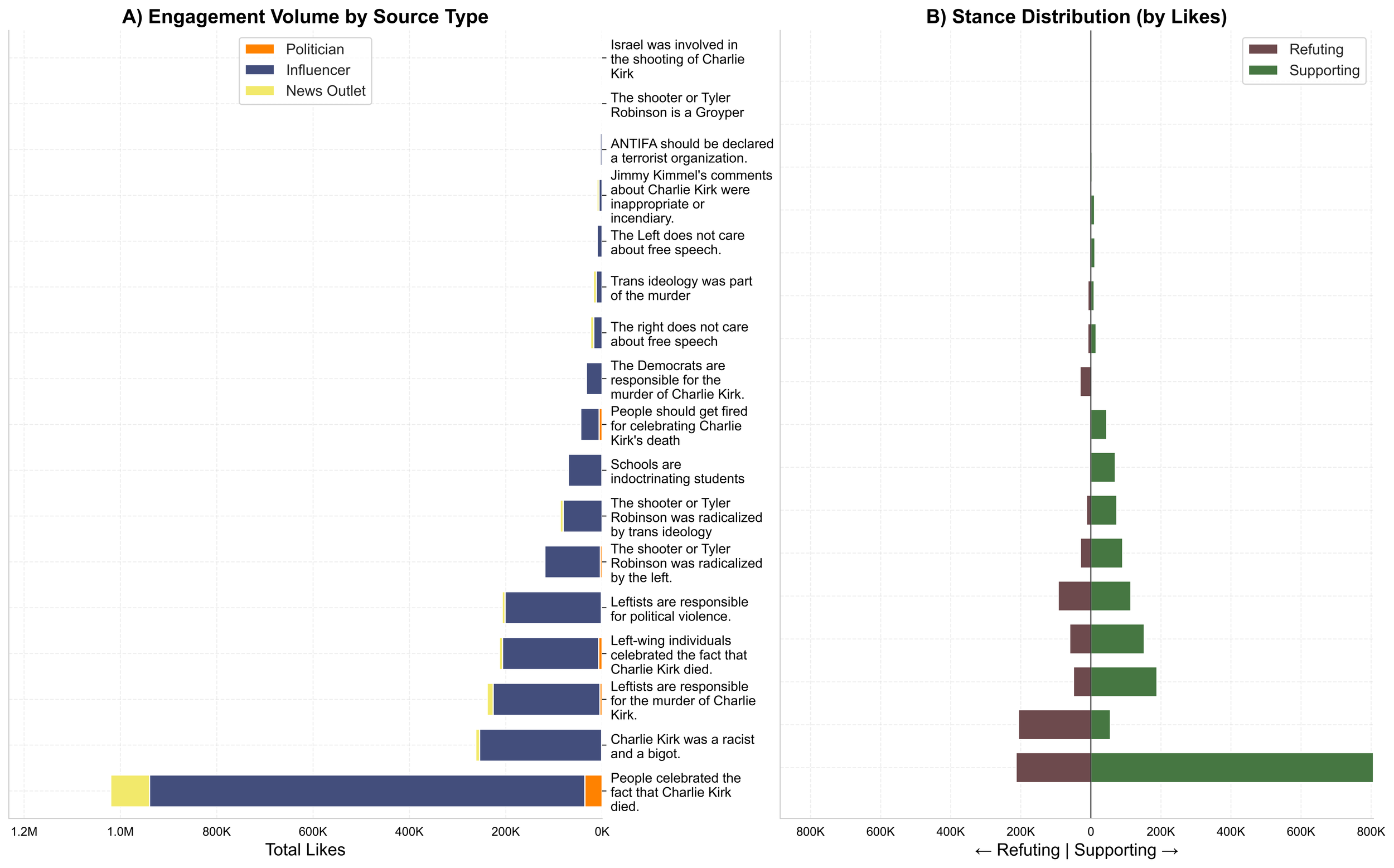
Figure 2. Total likes on X and TikTok for posts supporting or refuting each claim, broken down by user type (Left) and stance (Right)
As shown in Figure 3, for posts taking a supporting or refuting stance on the selected claims, Canadians primarily engaged with influencer content following the assassination of Charlie Kirk. Influencers received 89% likes on posts supporting or refuting a claim, while news outlets only received 7.5% and politicians barely 3%, even though news outlets produced nearly half as many posts as influencers (233 vs 451). We conclude that influencers were the main drivers of opinionated conversation around the assassination of Charlie Kirk in the Canadian information ecosystem. This demonstrates how influencers played a key role in shaping how narratives were framed and subsequently consumed. Consistent with our recent brief on the political influence of Canadian influencers and IU2, they provide interpretive frames that drive Canadians' understanding of political events.
Similarly to the general conversation we studied in the initial part of this update, claims regarding users celebrating the assassination of Charlie Kirk received the most engagement*, a little over 1 million likes. We also find that comments about Kirk’s character were quite popular: the claim regarding Kirk being a racist and a bigot generated the second most engagement, with influencers mostly refuting the claim. Claims blaming the left for the assassination and for political violence also received comparatively high engagement, most of which came from supportive posts. Interestingly, while posts refuting polarizing claims received most of the engagement in the overall online environment, posts supporting these claims received more engagement when focusing on Canadian political figures (news outlets, influencers, politicians, and civil society organisations). While our data do not allow formal testing, this pattern may reflect either the greater supply of content from right-leaning influencers in the Canadian context (most top claims are congenial to the right) or the fact that much of the refuting content originated from ordinary users rather than opinion leaders. Finally, we find that posts making a stance on Israel's role in the shooting, the shooter’s affiliation to the Groyper movement, and the status of ANTIFA as a terrorist organization received little to no attention among Canadian influencers.
The high concentration of engagement on influencer content in Figure 3 does not mean, however, that news outlets had no influence on the conversation. When we also consider posts discussing each claim, not just those that supported or refuted them, we find that news outlets received 30% likes. Similar to IU2, news outlets largely played an informative role, providing updates on the public’s response and the investigation as information became publicly available.
Finally, politicians’ behaviour also aligned with our findings in IU2: they largely remained out of the conversation, providing little to no commentary whether promoting or discussing different narratives. Civil society organizations similarly produced very little content supporting or refuting these claims, and the posts they did publish received limited engagement.
These findings suggest that American political events gain traction in the Canadian information ecosystem but do not necessarily dominate Canadian online discourse. Canadian influencers play a key role in interpreting events and disseminating claims and narratives in the Canadian context, whereas news outlets see their role as providing informational updates on ongoing events. The Kirk incident, however, does not reveal a pronounced partisan debate among Canadian politicians, as shown by the minimal engagement and commentary from this group.
Conclusion
Our analysis demonstrates how X and TikTok users engaged with polarizing and conspiratorial claims about the assassination of Charlie Kirk. Top claims about Kirk demonstrate a wide range of partisan discourse, speculation around the shooter and his motives, the role of political ideologies in the assassination, and critique of Kirk’s character. These claims generated greater posting activity on X, but most of the engagement occurred on TikTok. Our claim-extraction model suggests that a large bulk of the discourse focused on refuting partisan blame. This pattern is largely consistent across posting and engagement activity.
The claims responsible for the largest number of posts and engagement focused on reactions to Charlie Kirk’s death, such as “People celebrated the fact that Charlie Kirk died”. The high prevalence of both refuting and supporting content demonstrates that there was no clear ideological or narrative dominance, highlighting the polarized nature of online discussion.
Our analysis indicates that speculative claims about the identity and motive of the shooter emerged rapidly following the incident, especially on X. Polarized and conspiratorial narratives that originated in the United States permeated the Canadian online environment. Canadian influencers were drivers of these narratives, but overall activity was limited.
Overall, this incident update illustrates how major political events can quickly spark polarized, conspiratorial narratives in the online environment. Audiences are quick to engage with these narratives, with discussions reflecting disagreements over the causes of the incident and its broader social consequences. The influence of American events in Canadian online discourse underscores the permeability of the Canadian information environment and the importance of monitoring how U.S.-based polarization can transport into the Canadian context.
Methodology
What do we mean by claims? We understand a ‘claim’ to be a statement provides a meaningful and interesting stance, framing an opinion about a particular viewpoint or issue as fact or truth. We view the process of differentiating claims as extracting all atomic units within a social media post or transcript that express a single stated opinion or assertion about the world. For example, on September 18, former US President Barack Obama posted on X:
“After years of complaining about cancel culture, the current administration has taken it to a new and dangerous level by routinely threatening regulatory action against media companies unless they muzzle or fire reporters and commentators it doesn’t like.”
This post can be broken down into the following claims:
The current administration has complained about cancel culture for years.
The current administration has taken cancel culture to a new and dangerous level.
The current administration routinely threatens regulatory action against media companies.
The current administration threatens regulatory action against media companies unless they muzzle or fire reporters and commentators it doesn’t like.
What do we mean by claims? We understand a ‘claim’ to be a statement provides a meaningful and interesting stance, framing an opinion about a particular viewpoint or issue as fact or truth. We view the process of differentiating claims as extracting all atomic units within a social media post or transcript that express a single stated opinion or assertion about the world. For example, on September 18, former US President Barack Obama posted on X:
“After years of complaining about cancel culture, the current administration has taken it to a new and dangerous level by routinely threatening regulatory action against media companies unless they muzzle or fire reporters and commentators it doesn’t like.”
This post can be broken down into the following claims:
The current administration has complained about cancel culture for years.
The current administration has taken cancel culture to a new and dangerous level.
The current administration routinely threatens regulatory action against media companies.
The current administration threatens regulatory action against media companies unless they muzzle or fire reporters and commentators it doesn’t like.
*By claims about user celebration we are referring to "People celebrated the fact that Charlie Kirk died," "People should get fired for celebrating Charlie Kirk's death," "Left-wing individuals celebrated the fact that Charlie Kirk died."