
Incident Update 8︱Foreign State Creators’ Response to the Charlie Kirk Assassination
Authors & Organization
Aengus Bridgman
Organization: Media Ecosystem Observatory
Key takeaways
Russia devoted far more attention to the event than China or India, relative to their typical coverage of North American politics: Russian state-affiliated creators increased their already high attention to North American topics by about 13 percentage points after the assassination, indicating a strategic focus on this event, whereas Chinese and Indian state creators’ coverage remained consistent with their usual attention to North America.
Russia stood out for advancing overtly polarized narratives: Russian state-affiliated creators promoted highly politicized and conspiratorial claims and interpretations of the events, while Indian state-affiliated creators focused on factual reporting without editorializing, and Chinese state-affiliated creators focused on democratic (in)stability and violence in the U.S.
Russia’s response to the Kirk assassination fits a broader, recurring pattern in its coverage of major U.S. events: Across multiple moments, including the Trump assassination attempt, the 2025 U.S. election, the LA wildfires, and the first Trump-Zelensky meeting in the White House, state-affiliated creators consistently used U.S. news events to advance narratives of Western dysfunction, hypocrisy, and decline. The response to the Kirk assassination is representative of a stable communicative strategy in which Russia exploits crises to amplify conspiracy theories, polarization, and institutional distrust.
Introduction
Context
Recent years have seen growing recognition that foreign states exploit social and political crises in Western democracies to advance influence operations and exacerbate domestic polarization. For example, the National Security and Intelligence Committee of Parliamentarians (NSICOP) in Canada devoted much of its 2024 “Special Report on Foreign Interference in Canada’s Democratic Processes and Institutions” to describing how state actors use covert and deceptive tactics including disinformation, online manipulation, and interference targeting diaspora communities to undermine trust in democratic institutions and public discourse. A high-profile event such as the assassination of Charlie Kirk may have provided a key opportunity for state-affiliated outlets to produce and spread disinformation campaigns. Early reports have widely reported that to be the case in this instance including Politico, Newsweek and ABCNews. This update uses social postings by known state-affiliated creators (media, organizations, and influencers) to evaluate the extent to which Russia, China, and India (three major foreign influence actors) contributed to the spread of disinformation.
Key questions
This report evaluates the following research questions:
What was the volume, timing, and engagement level of select foreign state-affiliated creators’ coverage of Charlie Kirk’s assassination?
How did state-affiliated creators from China, Russia, and India frame Charlie Kirk's assassination?
Was this pattern of attention and framing unusual?
Approach and Considerations
This analysis examines social media posts from 116 state-affiliated entities associated with China, Russia, and India. Accounts were identified based on platform disclosures* (where platforms have identified country of origin), self-identification as state-affiliated entities, and/or verification of their affiliation using independent media experts who monitor these countries' influence operations. The dataset comprises 939,883 posts collected across multiple platforms including X (formerly Twitter), Facebook, Instagram, YouTube, Telegram, and TikTok, covering the period from January 1, 2023 through September 23, 2025.
By "state-affiliated creators," we refer to organizations and individuals that receive funding from, are editorially influenced by, or operate under the direct authority of national governments. This includes entities explicitly labeled as state media (such as RT, CGTN, and DD News) as well as organizations and individuals with documented state connections through ownership structures, editorial oversight, or financial dependencies. We acknowledge that the degree of state affiliation varies across entities, ranging from direct government operation to more indirect forms of influence.
We employ topic modelling to assess the posts of these creators and evaluate the extent to which these focused on the United States, Canada, and what sort of frames they employ to discuss the Charlie Kirk assassination. See methodology for additional information about the approach employed.
1. What was the volume, timing, and engagement level of foreign state-affiliated creators’ coverage of Charlie Kirk’s assassination?
Russian, Indian, and Chinese creators have significant and continuous coverage of the United States. As shown in the top plot of Figure 1, the three-year baseline (2023-2025) showing attention among top topics to the United States (and Canada) ranges from 18% (India) to 29% (Russia). Canadian coverage is far lower than that of the United States and is comparably low across all three countries, although India does tend to cover Canadian stories at a slightly higher frequency (1.5% for India) than the others (1.2% for China and Russia). This high baseline attention to events in the United States is critical to understanding how state media might respond to potentially polarizing events.
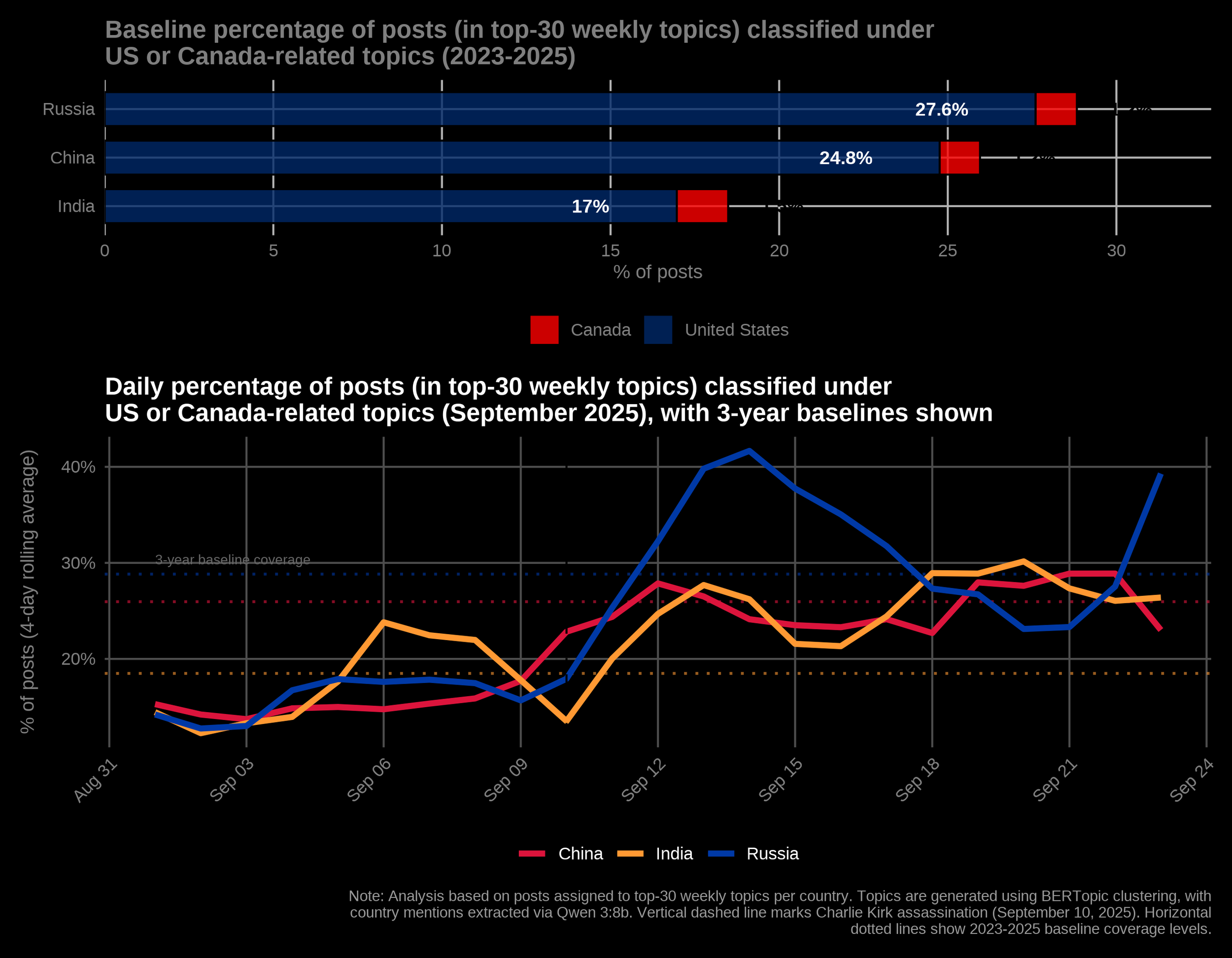
Figure 1. State-affiliated media coverage of the United States and Canada: September 2025 vs. baseline
The assassination of Charlie Kirk on September 10, 2025 produced a dramatic and immediate shift in attention toward the United States. In the days preceding the assassination, all three countries were tracking below their historical baselines, with Russian topic coverage at around 18%, well below its typical 29% level. Over the next several days, Russian state media topic coverage of North America soared to over 40%, representing a more than doubling of attention and substantially exceeding baseline levels. This spike was sustained for approximately one week before beginning to decline. Indian and Chinese state media showed more modest responses. Both increased their North American coverage following September 10, with India rising from 13% in the 2-weeks before to 28% and China from 15% to 28%. Notably, these post-assassination levels brought both countries roughly in line with or just above their historical baselines, suggesting the Kirk assassination generated sufficient news interest to temporarily elevate coverage to typical levels rather than producing exceptional attention.
The differential response across countries is revealing. Russia's exceeded its already high baseline by roughly 13 percentage points suggests either heightened editorial interest in US political violence or strategic prioritization of this particular event. In contrast, China and India's responses appear more consistent with routine news processing: coverage increased to meet baseline expectations but did not dramatically exceed them. The same patterns hold when looking at engagement rather than post volume.
2. How did state-affiliated creators from China, Russia, and India frame Charlie Kirk's assassination?
To better understand the response, we manually reviewed the 100 most engaged with posts about the assassination and fallout from each of China, Russia, and India to assess the extent to which the coverage was factual and news-oriented, or focused on conspiracies and polarizing claims.
Russian sources, particularly RT, adopted the most politically charged framing, systematically amplifying instances of Western figures celebrating Kirk's death from a New York comedian mocking the murder to a British rapper's profane tribute. RT's highest-engagement post (4,127 interactions) featured international solidarity ("We are Charlie Kirk" from South Korea), while the Russian Foreign Ministry's official statement explicitly framed the killing as "yet another manifestation of the entrenched Western ultraliberal view — one postulating that violence and terror are acceptable means of dealing with opponents." Russian coverage also promoted conspiratorial questioning of mainstream coverage of the event, with one viral post demonstrating that the rifle allegedly used "does not even fit" in a backpack as claimed, asking viewers "Do you buy the official Tyler Robinson story?" Several prominent Telegram posts framed Kirk's death apocalyptically as a "Turning Point" killed by "liberals, globalists, trans people and Soros agents."
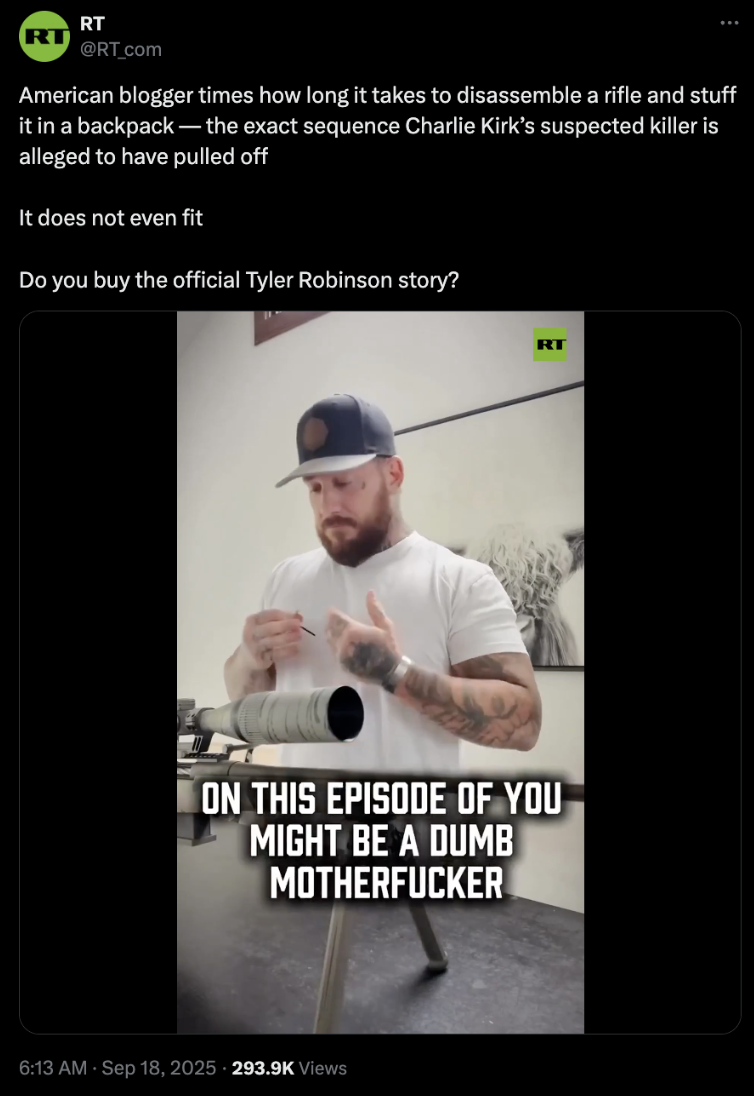
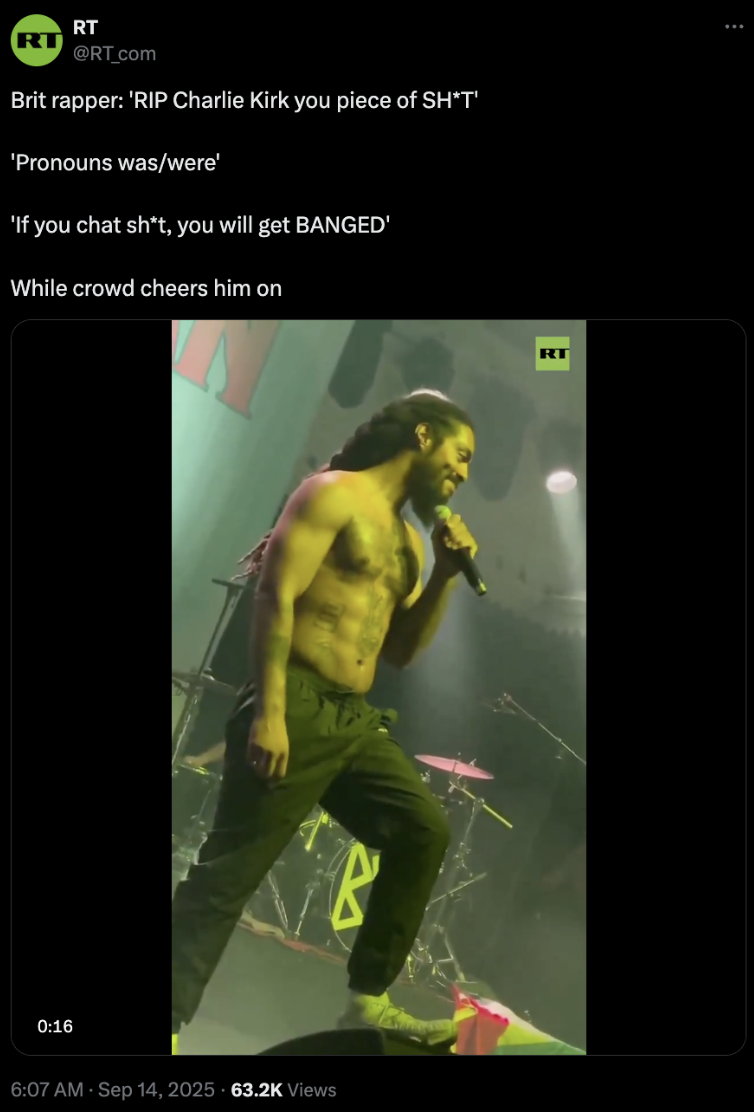
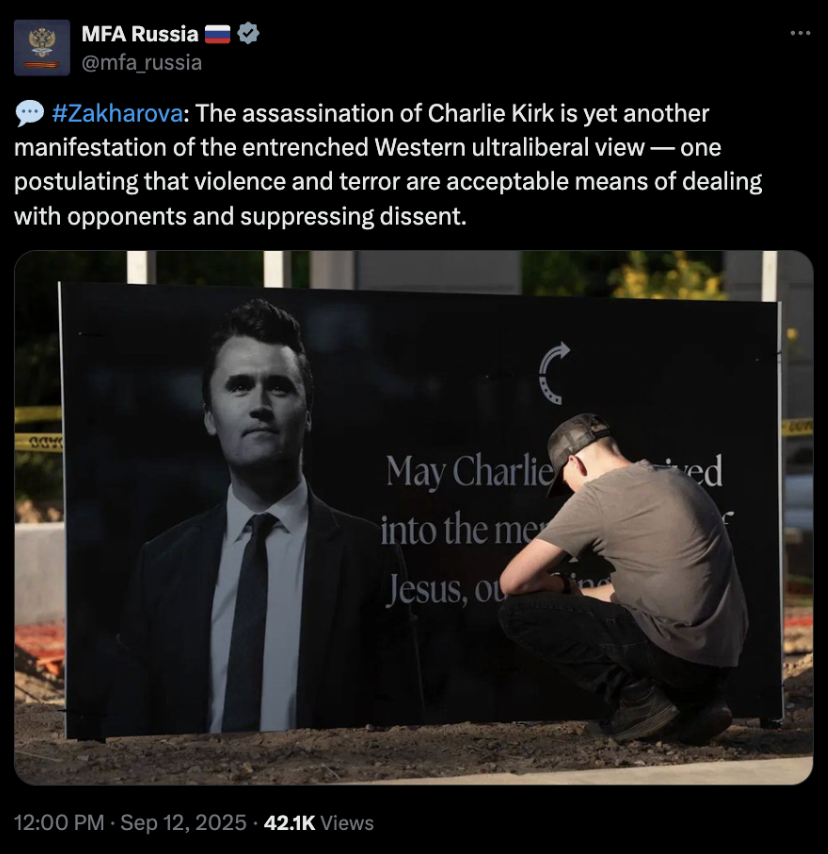
Figure 2. Examples of conspiratorial or polarizing claims pushed by Russian state-affiliated creators
Indian state-affiliated media took a different approach, functioning primarily as a high-volume news aggregator. India's top posts were dominated by straightforward video news coverage from outlets like FirstPost, India Today, Times of India, and Republic World, with the highest-engagement content simply showing the moment of the assassination. Indian coverage emphasized factual elements including the FBI investigation, suspect identification, and memorial services, without the political commentary prevalent in Russian content.
Chinese state media produced the least coverage, with content from CGTN and South China Morning Post maintaining a neutral, wire-service tone. China's coverage focused on factual reporting of events (e.g., Trump ally Charlie Kirk shot dead at Utah event) and when they did explore the broader context of American political violence: "What's behind the surge in violence in U.S. politics?", it was framed as an American domestic issue. Chinese sources, when editorializing, emphasized concerns about U.S. political polarization and free speech implications (particularly around the Jimmy Kimmel suspension), positioning itself as an observer of American dysfunction.
Was this pattern of attention and framing unusual?
To determine whether the heightened attention and polarizing framing from Russia to this event reflects a broader communicative pattern, we performed the same time analysis of five other significant events: 1) the assassination attempt of Trump on July 13, 2024; 2) the election of Donald Trump on November 5, 2025; 3) the Los Angeles Wildfires in January 2025; 4) the election of Mark Carney in Canada on April 28, 2025; 5) the Trump-Zelensky meeting in the White House on February 14, 2025.
The results demonstrate a consistent pattern where major political events in the United States prompt increased attention from Russia, India, and China. Note that the only Canadian event, the Canadian Federal Election, had some engagement several days earlier following the Lapu-Lapu Day festival where 11 people were killed in Vancouver. Those events actually received more attention than Carney and the Liberal Party of Canada winning the election, before Russian attention actually pivoted to anticipation/preparation for Victory Day celebrations. Put this way, the uptick in coverage of the Kirk assassination was relatively modest compared to other major events.
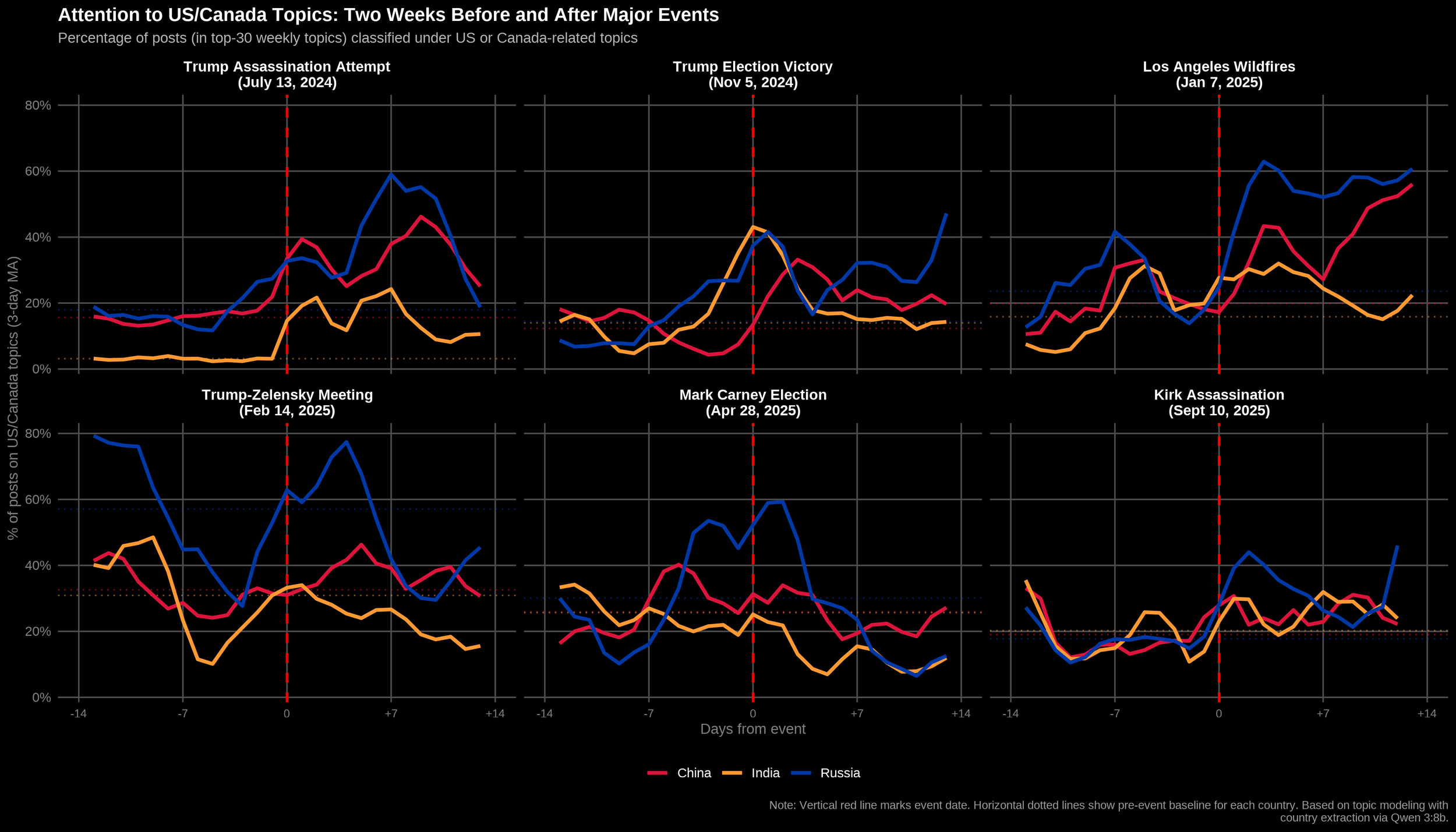
Figure 3. State-affiliated coverage of the United States and Canada: Six important political events
We did a similar review of Russian coverage and particularly the polarization and conspiratorial ideation across the six western-oriented events. For the Trump assassination, Russian coverage emphasized conspiracy theories about "deep state" involvement and CNN's initial downplaying of the event. For the Trump election, coverage adopted a triumphalist tone, highlighting liberal "meltdowns" and European establishment panic. For the LA Wildfires, Russian creators focused on governance failure narratives, with RT and affiliated accounts emphasizing empty fire hydrants, the California governor’s (Gavin Newsom) water mismanagement, DEI policies blamed for incompetence, and third-world comparisons to LA’s fire and water infrastructure. For the only Canadian event, the Lapu-Lapu Day festival saw neutral, respectful, and fact-oriented coverage which suggests that, while Canada also is subject to the same phenomena, Russian state-affiliated creators generally focus much more heavily on the United States.
Across all events, Russian state media employed a consistent underlying thesis: American/Western dysfunction, hypocrisy, and moral decay. There is a consistent pattern of Russian response to major U.S. news events that provide opportunities to push that narrative.
Conclusion
The assassination of Charlie Kirk prompted a rapid but uneven response across foreign state-affiliated media ecosystems, revealing important distinctions in how Russia, China, and India use moments of U.S. political crisis. Russia exhibited the most pronounced and concerted shift, dramatically increasing its attention to the United States and deploying overtly politicized, conspiratorial, and emotionally charged narratives that amplified polarization and questioned institutional legitimacy. India, by contrast, largely adopted a high-volume but straightforward news-reporting posture, emphasizing factual updates and avoiding explicit editorialization, while China maintained minimal, restrained coverage focused on political polarization and broader implications for democratic stability.
Taken together, these findings demonstrate that while major U.S. political events reliably attract attention from foreign state-affiliated creators, only Russia consistently uses such moments to amplify divisive and conspiratorial narratives. This distinction has meaningful implications for understanding how different states instrumentalize Western crises as opportunities to escalate polarized information environments.
Methodology
To identify recurring themes and topics within this corpus, we employed BERTopic, an unsupervised topic modeling technique that leverages transformer-based sentence embeddings to cluster semantically similar documents. Specifically, we used pre-computed embeddings from the paraphrase-multilingual-MiniLM-L12-v2 model, which supports multilingual content and captures semantic meaning across linguistic contexts. Put simply, this method groups documents that are similar in meaning, even if they use different words or are written in different languages. The top-30 topics were identified for each week and each source country (China, Russia, India), ranked by the number of posts classified within each topic.
To generate human-readable topic descriptions, key claims, country associations, and sentiment classifications, we employed the Qwen 3:8b large language model. For each topic, the model analyzed representative posts and generated: (1) a concise title summarizing the topic’s main theme, (2) a brief description elaborating on the topic’s content, (3) a list of countries mentioned or relevant to the topic, (4) key claims or narratives present within the topic, and (5) an overall sentiment classification (positive, negative, or neutral).
Country associations were extracted through this automated process, with topics classified as concerning the United States or Canada if either country appeared in the generated country list. All topics for the month of September were validated by a human coder and none were changed.
Note that the topic modeling process involves simplifying complex document information grouping similar documents that introduce some subjectivity in topic boundaries. Different modeling parameters or time windows might yield alternative topic structures. Second, our country detection relies on language model inference, which may occasionally misclassify topics or overlook implicit country references. Third, the analysis focuses primarily on content production rather than reach or impact. Note that the accounts included in this analysis represent a considerable but incomplete subset of state-affiliated creators and their presence on social media platforms. Finally, while we observe patterns in topic prevalence and country mentions, causal claims about coordination, strategic intent, or effects on public opinion are beyond the scope here. These findings should be interpreted as descriptive patterns in state-affiliated creators’ production rather than evidence of coordinated influence operations.