
Facebook’s News Slop Economy
Inside a foreign-run AI content-farm network monetizing fake news across Canada, the US, the UK, and Europe
Information Incident
Last updated: June 22, 2026
Key takeaways | Context & incident assessment | Concluding remarks
Key takeaways
A coordinated network of 340 Facebook pages — largely operated from Vietnam — targets users in Canada, Europe, and the US with AI-fabricated stories about politics, celebrities, and sports to drive traffic to fabricated-news websites and generate ad revenue.
Through Google’s advertising systems and other automated ad exchanges, public-sector organizations and companies — including in Canada — inadvertently fund the network’s business model.
The pages command large audiences (median 11,000 followers): their posts have drawn more than 95 million reactions, comments, and shares since 2025. The network has published 355,296 posts in that period, with a peak of 3,919 posts on a single day (May 4, 2026).
The activity is strongly coordinated: the pages are created and renamed in synchronized batches, and they recycle the same fabricated stories across the network, reusing one template for different public figures, including politicians from opposing parties.
A fact-check of stories in the network’s Canadian news pages (5,894 posts) found that 54% were false or unsupported, typically pairing a real topic with a fabricated quote, statistic, or fictional dramatized account.
Context & incident assessment
In the attention economy, social media platforms have become a well-known medium for profit-driven content creation, with a business model that rewards whatever captures the most attention. Users are familiar with clickbait, whether cute pet videos or outrageous rumours. The Institute for Strategic Dialogue documented in 2022 how conspiracy theories have been monetized, and generative AI has since made producing such stories at scale cheaper, making content farms more lucrative.
The issue has become the subject of litigation. In February 2026, Meta filed lawsuits against deceptive advertisers in Brazil and China and against a Vietnam-based advertiser who used cloaking to run a subscription-fraud scheme. In Canada, a class action was authorized against Meta on behalf of victims of cryptocurrency scams advertised on Facebook.
As a Canadian research observatory, we began by investigating AI-fabricated content reaching Canadian Facebook users. That investigation led us outward: the pages targeting Canada turned out to be one arm of a coordinated, politically salient international network. We follow that thread in full while keeping Canada in focus, both because it is our mandate and because the clearest evidence of the network’s business model — the Canadian advertising dollars funding it — is the part we can document end to end. Amid these developments, we identify a coordinated network of 340 Facebook pages (largely operated from Vietnam, among those that disclose an administrator) that use AI-fabricated news stories about high-engagement topics in Canada, Europe, and the US to generate advertising revenue. The 340 pages we document are likely a lower bound: new pages kept surfacing throughout our investigation, as others were taken down, suggesting the network was still active and expanding as we wrote. The pages repeatedly republish the same fabricated stories while substituting their subjects (i.e. interchanging the names of politicians, sports teams, public figures, and celebrities across otherwise identical stories). These content farms generate significant engagement on Facebook, driving traffic to fabricated-news websites that are monetized through advertising. This includes legitimate campaigns from Canadian public and private organizations, meaning Canadian advertising dollars inadvertently help fund the network.
We find many similarities between this network and documented cryptocurrency scams on Facebook, including the bulk creation of pages and the use of clickbait AI-fabricated stories about high-engagement topics. The main difference is the business model, which appears centered on advertising revenue rather than financial fraud targeting citizens. Unlike a typical foreign influence operation, those behind this effort appear driven primarily by commercial rather than political incentives: across much of the network, the same fabricated stories are reused interchangeably for politicians from different parties, as a content farm chasing engagement would. A commercial motive does not make the content harmless, however. To maximize engagement the operators amplify whatever provokes the strongest reaction, and some of it — most notably the large volume of anti-immigration and anti-Muslim content aimed at UK audiences — is inflammatory. Irrespective of intent, the result is a flood of misleading, often politically charged headlines circulating on social media, particularly on Facebook.
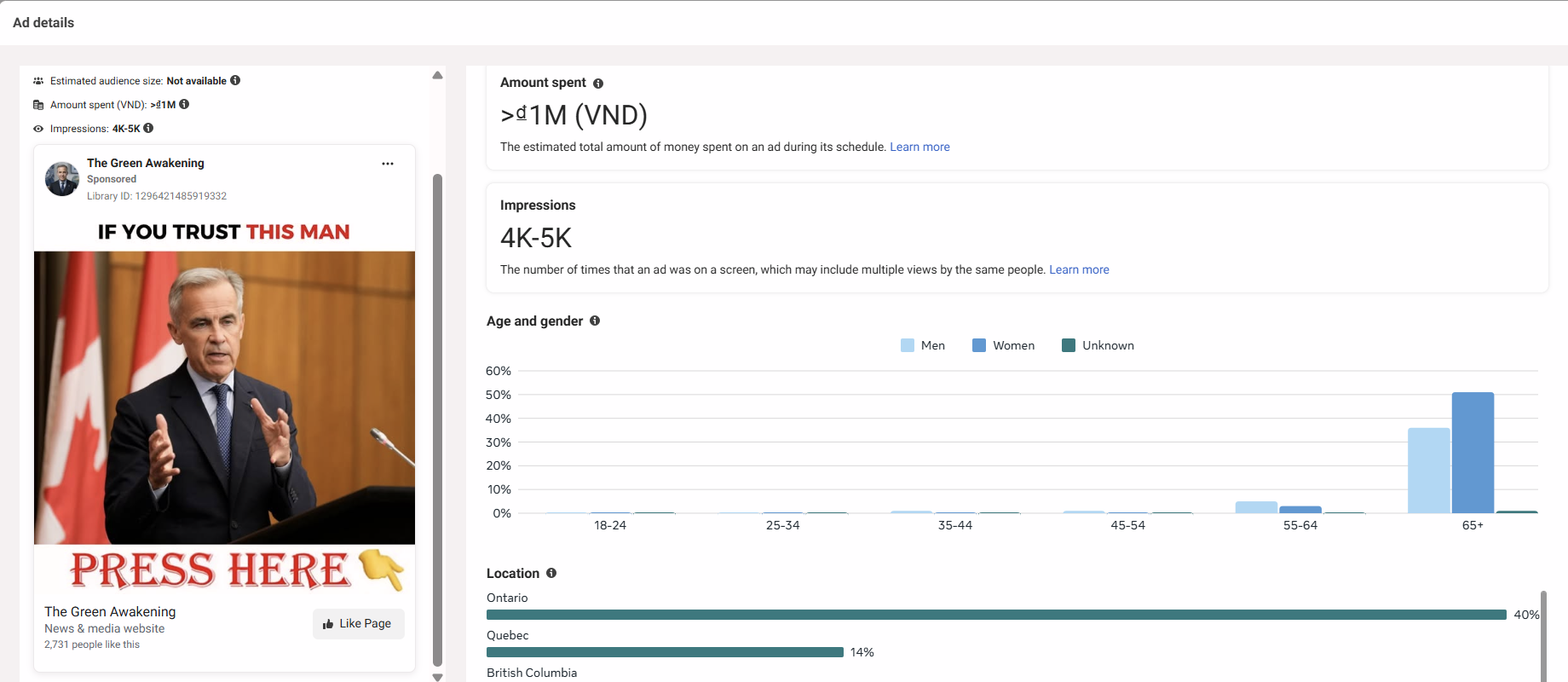
Screenshot from Meta Ad Library showing a Vietnam-operated Facebook page targeting Canadians with AI-generated Ad content.
Concluding remarks
This incident provides rich evidence that some foreign actors will flood an information ecosystem with fabricated news primarily to generate revenue rather than to pursue a strategic or political objective. A commercial motive does not, however, make the content harmless. Given the network’s massive reach, it floods information ecosystems with fabricated stories that can fuel disinformation narratives and contribute to social tensions. Notably, the fabricated anti-immigration and anti-Muslim stories aimed at UK audiences are particularly concerning, and could be replicated in other countries, deepening polarization.
Social media companies play a crucial role in monitoring the content they host and how their algorithms and monetization structures reward particular actors. While platforms and regulators can act to reduce the visibility and monetization of this content, Canadians’ ability to recognize and avoid AI-generated spam can also help make the underlying business model less profitable. Advertising systems and advertisers can also contribute to reducing incentives in this business model by redirecting their investments accordingly.